ParentingPreschoolers66 Comments
Get the skinny on what basic life skills your preschooler needs to know from early childhood expert Deborah J. Stewart from Teach Preschool. She shares with us what things to teach a 3 year old.
When Henry started preschool, I started thinking about life skills for kids to know and wondering if Henry can do what he should be doing at this time.
As a parent, I often wonder if Henry’s on the right track. If he’s doing everything he should be doing. Or if he’s lacking in an area.
When he was younger, I’d track all the developmental charts to make sure he’s on track. But somewhere along the way, well, I stopped.
What should he be doing?
Essential Basic Life Skills for a Preschooler to Know
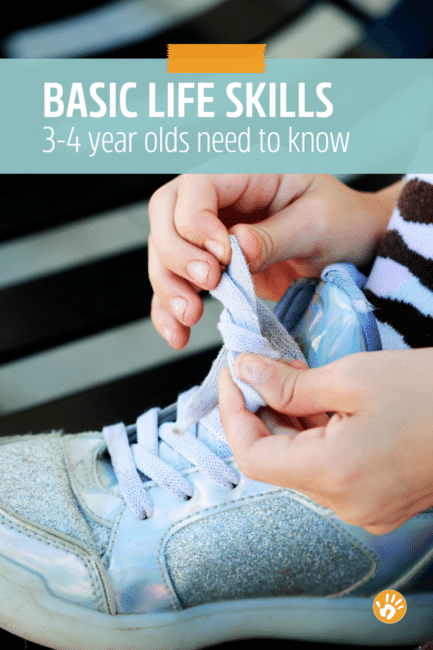
I asked Deborah J. Stewart, M.Ed, early childhood educator and author of the blog Teach Preschool, about what life skills young kids should be doing.
To start, I asked what things she hopes to see 3 year olds doing when they enter preschool.
Deborah suggests that parents encourage independence in their child by:
- Assist their child learn how to put on or take off their own coat or jacket.
- Helping their child learn to stuff their mittens in a pocket or hat when they take it off rather than just dropping them on the floor.
- Reminding their child they know how to pull up or down their own pants.
“I always help but we want preschoolers to be self-sufficient as soon as possible,” Deborah shares.
Basically, Deborah says that “Any task a child can learn to do on his or her own that relates to taking care of his or her own body or getting dressed or putting things away in the backpack will help the child be more independent and confident in preschool.“
By the end of the school year, Deborah says a preschooler should be able to do the following basic life skills:
- Put on their own jacket, mittens, hats
- Put papers away in their backpacks
- Fold up their own clothes or blankets and put them away
- Help clean up toys and materials at clean up time
- Set their own tablespace for snack and throw away their own trash after snack
“Ultimately, by the time they enter our four-year-old program, I want the threes to be past the stage of total dependence and able to do most personal care process and organizational processes on their own,” explains Deborah.
“When we get into the four’s/Pre-K program, we want to focus on more advanced skills and not still be spending lots of time trying to find mittens or zipping up backpacks!”
Starting Small Basic Life Skills at Home for Preschool
With Deborah’s suggestions, I’ve learned to start allowing time for Henry to do things on his own.
Allowing another 5-10 minutes to get out the door each morning, so Henry can put on his own shoes.
At night before bedtime, I’ve started letting Henry dress himself in his pajamas or “pee-gay-gays” as Henry calls them.
These are loose fitting clothes that are easy practice for him.
Taking this extra time for a preschooler to master new life skills is so rewarding.
He recently started doing this entirely on his own and is very proud of himself.
He’s now starting to tackle getting dressed in the morning.
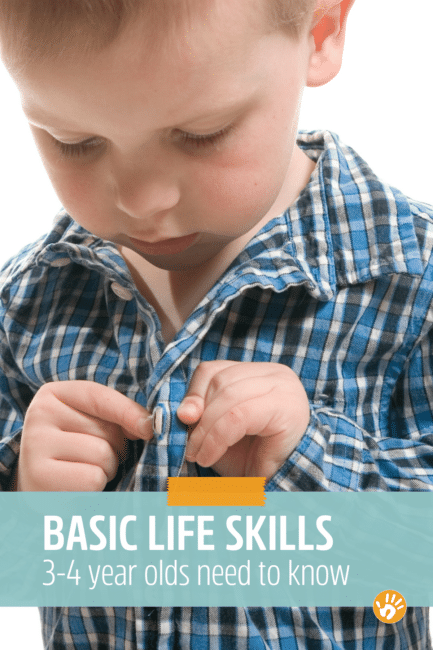
Knowing what to expect is one thing, but relaying those expectations to your child provides another challenge.
Deborah says that how she teaches the life skills to 3 year olds in her preschool can be applied at home, too!
Make Life Skills Task Expectations Super Clear
“I think the first place you start is making sure your expectations, both at home and in the classroom, are clear,” Deborah says.
“This requires breaking things down for the children step by step and teaching them what it is you are expecting them to understand.”
“My belief is if you haven’t taught the child the process then a rule can’t be understood or followed.”
For very young children, 2 – 3 year old, I start with teaching expectations first and foremost.
We practice the skills that I need them to understand.
First, Deborah will explain the life skill to the preschooler, like washing hands to make the germs disappear.
But she also breaks down the overarching skill into smaller sub-tasks:
- take one pump of soap from the bottle
- turning on the water
- rubbing hands together
- rinsing hands
- using just one paper towel to dry hands
- where to throw the towel away
- turn the water off
It’s not just saying “wash your hands” and expecting a child to do the skill.
It’s truly teaching all the tiny steps of washing hands that are second nature to adults, but brand new to kids.
This totally changed my view of teaching these basic life skills to my preschooler!
I’m so glad that I asked Deborah!
Knowing What Behaviors & Skills Are Truly Age-Appropriate
Henry has always been quite a loud child.
When he’s playing with friends, he always has the loudest motor! And at the library or in stores, I am constantly telling him to use his inside voice.
Teaching him to use this “inside voice” has been difficult for me and hard for him to understand.
I asked myself if this is a life skill appropriate for a preschooler or not, can I teach a 3 year old to be quiet?
I’m mostly okay with Henry being loud. I love his enthusiasm and excitement, but there are times when we’re expected to be quiet.
At this age, this seems to still be a common occurrence and Deborah explains why:
“Young children are still ‘all about me’ when it comes to their development, so they are not aware of how they are affecting others around them. This is a skill that needs to be taught rather than told.”
So maybe teaching and expecting my boisterous 3 year old to respect the silence of a fancy art museum or other more serious place isn’t quite appropriate just yet.
Model Ideal Life Skills to Your Preschooler
Even though Henry might not be 100% ready to use his inside voice all the time, or even at all, it won’t stop me from asking.
Or modeling what quiet looks like.
Modeling the behavior that you expect just before you expect it makes it stick in their mind.
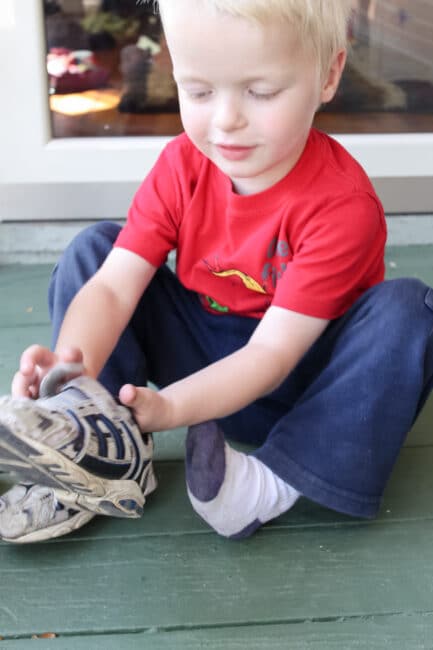
Deborah says, “The child will probably think this is funny but it will help him remember what you expect and practice the skill of using a quiet voice.”
Along with Life Skills for preschool, learn how to teach responsibility to kids too!
This modeling approach not only teaches what you expect from the child, but it puts in a fun learning twist as well.
Tips for Teaching a 3 Year Old to Use an Inside Voice
If your child is using a loud voice to talk to you at home or in the store, stop and softly say something like,
“Are you talking to me?”
“I thought you must be talking to that lady way over there because she can hear you better than me.”
In other words, teach your child to judge the need for using a loud voice to talk to someone far away versus a casual or normal voice when standing right next to you.
But above all – be aware that you model appropriate talking tones and levels.
Modelling the life skill to a preschooler will enhance everything your are teaching especially with a 3 year old.
If you are shouting “Don’t talk so loud!” then you are not modeling the behavior you’re expecting from your child.
And that sends mixed messages.
Another approach Deborah takes is to show how the children’s’ actions are affecting others. Deborah says to try things like:
“Your loud voice is hurting my ears!”
“I can’t understand what you say when you talk so loud. So let’s try it again and use a normal voice.”
This all revolves around teaching expectations and helping young children to be successful in life.
Everything is New for Young Children
When considering teaching life skills to a 3 year old, one thing Deborah would tell parents of all preschool children is:
“Look at EVERYTHING as an opportunity to teach and to learn.”
Preschool age children are discovering their world as well as the boundaries in their world.
They need both the space to try and fail. And the support to try and succeed.
Look at every new task or interest a child explores or tries as small opportunities to teach them.
And then where possible, give them the tools they need to be independently successful in the process.
Understand that independence doesn’t mean letting a child run around wildly wrecking up the living room.
What it means is giving children the time, space, and opportunity to explore the environment or a new idea.
And then guiding that child towards the understanding, skills, and discipline he needs to be successful in both the home and classroom environment.”
My latest motto is to treat my parenting approach as a teacher would their teaching approach.
I find that all teachers are so calm and collected.
Yes, because it’s expected of them, but the children respond to this so well. Can I manage this as a parent?
What essential life skills are you working on with your preschooler? We’d love to check out your best strategies and suggestions!
Try these affiliate links to products that teach about life skills and helping at home!
- The Berenstain Bears and the Messy Room
- Dress Up Pirate
- Calliou Puts Away His Toys
- Melissa & Doug Dust, Sweep, Mop, (Frustration Free Packaging)
- Red Lace, Yellow Lace Board book
- Kids Gardening Tools Set for Toddler & Preschool
WANT TO SAVE THIS ACTIVITY?
Enter your email below & we'll send it straight to your inbox so you can access this activity later! Plus, you'll get simple activities from us every week!
 How to Teach Kids Responsibility
 8 Ways to Prepare Your Child for Preschool
 How to Cope with Night Terrors

Nayeli Perez says
I do this with my girls after school even thought they are older. There is nothing more educational then hands on interactive games. I modify playing for different skills but kids like having fun. I like whey they are happy and they like to learn. It is a win-win situation.
Karen R Rymer says
Thanks for explaining some things about parenting order Alberta. I’m glad you explained you should learn if they participate in the Parenting Order Alberta I’m kind of interested to learn more as to what this participation would entail.
Steve says
If you want to teach your child to play life skills, introduce chess to him. The development of the brain’s left hemisphere which is responsible for logical thinking takes place through counting combinations, whereas the development of the right hemisphere, which is responsible for creative thinking, occurs by arranging new plans and finding new non-standard moves in different positions. Everything is conecting here in the best “math mixture”. Play chess with your kids, they will thank you later. If you need help in introducing this game, book by Maksim Aksanov is a great choice (net-bossorg/chess-puzzles-for-kids-by-maksim-aksanov). Of course it’s avaliable in electronic format, so you can have it on your phone or tablet.
Beth says
I would love to see something like this in a printable form
May says
Addressing others with “please”, “thank you”, “Good morning”, “excuse me”, eye to eye conversations, and the like.
Lili says
My 2 year old know how to go pee and poop by himself and clean himself too. Take a shower and wash his body. Make his bed and get dress by himself. He picks his clothes everyday and put his shoes on by himself. I have 4 kids and all of them have learned to do this at early age. I think discipline, presistence, and giving them responsibilities at early age is essential. We underestimate kids capacities.
Huma says
Hi,you inspired me a lot but my three years old not responding me .he never tell me about poop despite teach him in all ways.how you train them?
Adrienne Conner says
My daughters’ 3 yr Preschool teacher taught her how to put her coat on by herself. Lay the coat down on the floor with the top of the coat near your feet. Slide hands into the arms of the coat, put the coat over your head and around you. I can’t tell you the sense of pride my now 4 year old feels and how many younger kids in our weekly playgroup that she has taught how to do this. Proud Mama!!
Sashila says
Thank you so much for posting this. I loved it thoroughly . I have recently just started a preschool and I look forward into inculcating all these skills into my kids at school too ^_^
Susan Masters says
Great advice as a grandparent you have the time to look back and consider what the best thing you gave your children it was your time. Time to show them again and again the life skills they need . It’s good training for parents too be organised get up in time and it is precious time !
janet swiler says
I am a grandparent, and I would say learning to say thank you,no thank you, yes please, excuse me, and to see children stay in their places while in a restaurant, or staying under control in the marketplace. Good reading. Thank you.
Fadouia says
We all want our kids to do so but some parents specially being single parent aren’t getting enough understandin to there situation. Plus others they teach their children all the good things but they end up being special needs and recognised when they start school for few years so I would apreciate as well if we see a parent struggling with her child in restaurants or public places to not say oh what a mother what bad manners becausr what you see actually isn’t what you think. Thank you for your time reading my note
Annono says
I believe if you work with your kids they learn early on. My child and the nieces of mine were all potty trained way before two years of age. The three year old is writing and doing math as the two year old knows her numbers and letters. The iPad is a great learning tool. Kids love to learn.
Lisa McMannis says
The research has shown that children learning to read and do math that young isn’t necessarily beneficial. Not only is it taking time away from free play, which child educators agree is the most important factor in the success of young children, but there’s a good chance it will be forgotten. It can make children dislike school, and it can add undue stress to their lives. If they pick it up naturally that’s fine. But to push that on them can be a detriment.
Karen says
It is nice to have such great parenting advice. Sometimes I feel like the blind leading the blind when it comes to what I should be teaching my 3 yr old.
Celeste says
Great article thanks! Just wanted to let you know that my son was always a LOUD talker as well. We had his ears checked and it turned out he had a ton of fluid in his ears causing a 60% hearing loss. We got tubes placed in and we have seen an AMAZING difference. Just thought that may be helpful.
Kristine Duehl says
My 3.5 yr old CAN do all of these things. Getting him to DO them is another story. He has slowly been refusing to do more and more stuff. Pull up his pants after he uses the bathroom? He could do it 2 months ago and now refuses to do it. He will just walk around without his pants on. I’ve tried every way I know to encourage him to do it, but he just says “my hands don’t work, mommy, you need to help me.” I realize all this is his way of getting more attention now that his little brother is 9 months and requires more supervision, but I can’t seem to figure out how to demotivate him while still being understanding and supportive of his need for attention.
[email protected] says
Teach him to help with his brother. I am 75 years old, three years older than my brother. I remember going to the frig and getting a bottle of formula and heating on the stove, testing the tempeture on my arm and bringing it to the bedroom to feed my brother. It was a morning ritual, my twin sister and I were rewarded with an apple which mother would slice and feed us.
Lisa says
My son who is 3.5 year old is the same way. I’ve been trying sticker awards for potty by self, and am sometimes successful. He’ll put on his pants, wash his hands, then choose a sticker. Unintentionally, I only had abc stickers, but it worked out well because he reads the letter and color to me that he chooses.
natatikarn says
Thanks so much for this wonderful post.
Temesgen says
I thought I’d have to read a book for a dirsevocy like this!
Tazz says
As an elementary school teacher, I was shocked but not surprised to see some of my kids didnt know how to do basic things, like putting their stuff away or cleaning after themselves. This is due to parents coddling and not allowing them to do it for themselves (‘he’s too little/she’s too small for that/oh that seem’s hard’ etc). I believe in letting the children try, even if it seems difficult. Basic stuff like arranging their stuff, putting them away, being respectful to others is something they can all learn and start doing. The look in their faces when they realise they can do something is always something I love to see!
Cheryll P says
It’s not always coddling, although that is certainly one cause – one giant challenge I see in my own home is that my husband prefers things cleaned up or put away a certain way – and my almost-3 year old simply cannot always remember the complicated system or do it quickly enough, so he gets removed from the opportunity and cleaning happens magically after he’s in bed. Then, when he’s away from home and the toys or bins are different – even the system he thought he sort-of knew fails to make sense, too. We parents need to be patient, provide many different ways to show what constitutes success in tasks, and allow for mistakes and corrections. Likewise, we need to check out what happens in the classroom or elsewhere and try to draw connections, not boundaries. Patience and flexibility are so useful in cultivating problem-solving.
Jevemor says
I fully agree. I had to teach my daughter to be independent from a very early age, mainly out of necessity, because I am disabled. She started walking at 9 months, and I hardly carried her around after that. (Kind of wish I could have..) but it made me realize that she could do anything, if given the opportunity. By the time she was speaking, she spoke with good manners..She was dressing herself, and putting dirty clothes in hamper. It may seem strict to some that I have her set places at the table, and clear her plate when she’s finished…but these are all skills that need to be taught early, otherwise it’s hell to pay to try to backtrack and “fix” things you didn’t teach them. She just turned five, yet I hardly ever remember having to seriously discipline her, because she knew her limits and my expectations. She testing the limits a bit now, but I’m glad to only have ONE area to work on, rather than a rowdy, disrespectful child, starting from step one.
Mars M. says
This is such a good read. I’m a Montessori teacher and soon-to-be-mom and I was thinking along the same lines–my parenting approach pretty much the same as my teaching approach. But I keep thinking that I get the children in my classes for at least 3 hours a day–I wonder how I’d fare if I have to do this 24/7 with my baby. Here’s to hoping we can manage. :)
Mars M.
http://www.montessoriinmars.blogspot.com
Tazz says
don’t worry! If you’re a conscious parent, you’ll be fine. I teach elementary and now have a baby of my own. I find that I treat him the way I do my students. You really can;t change who you are, and if you’re a fantastic teacher, then you’ll be a fantastic mother too. esp when teaching is something you cannot fake. It has to come from the heart :)
Katie King says
Two ways we teach independence at our school is hand washing and getting into winter clothes. We use the 1 rule with hand washing. 1 dunk in the water to get hands wet, 1 squirt of soap, 1 song…(Frere Jacques) “Tops and bottoms, tops and bottoms, in between, in between, round and round, round and round, now they’re clean, now they’re clean!” 1 paper towel, 1 trash can!! For winter wear we say….First your snow pants, then your boots, coat, hat and mittens!!
Resh says
Wonderful tips & great way to teach parents like me to be better teachers. Thank you
Jamie Reimer says
You’re welcome Resh.
Lynne says
This is perfect.
As a JK/SK teacher, I’d like this to be required reading for all my parents of kids new to JK (often not yet 4) and even those SK parents who still don’t see the need to encourage independence.
Thank-you!
Jamie Reimer says
Thank you Lynne. Deborah knows her stuff!
Teacher bianca says
Recognition of their own and others’ emotions and how to respond to these. :)
Jamie Reimer says
Good addition to the list!
Kathryn says
I love that our daughter and son-in-law taught all four of their children to say, “I don’t care for this or care for that. Instead of, “I don’t like this or that. And “hate” is never used. Having the support of other parents that also teach there children manners is a big help from what I experienced.
Danie says
As a preschool teacher of those ages, I’d just like to add MANNERS! I completely understand that they are children – they won’t always say please, or thank you, or even ask nicely. But I can’t tell you the amount of kids who just say “give me that” or “i want a drink.” What we’ve been working on in my class is yes, please/no, thank you at meal times. And asking, instead of demanding.
Delores says
That has been a big problem in our classroom too! We also have a problem with children saying ‘I don’t like that!’ instead of ‘No, thank you!’ One thing for sure, every moment in preschool is a teaching opportunity!
Amie M says
I saw this on Pinterest today and looked forward to reading it during a brief break from the kids :) Great post! I have to say I am actually pleased it is not a HUGE list and is really quite do-able. I’ll be implementing the fold own clothes and setting the table over the weekend. Can I just add that I am also working on wiping themselves after the toilet. I expect that when Chook attends Kindergarten next year (4 – 5 year olds in Australia) he will be expected to be able to take just enough toilet paper and be able to wipe himself. He’s doing really well :)
Sarah @ How Wee Learn says
Great ideas! As a Kindergarten Teacher it is always important to remember all the learning that happens before kindergarten – and there is a ton! I am focusing on ‘1 skill at a time to teach children to be polite’ with my wee ones right now. I think manners and politeness are important life skills too. Excellent article – thank you both for sharing!!
Jamie Reimer says
Oh, I could use any tips you have for teaching kids to be polite. Any tricks you can share?
Sarah says
Hi Jaime,
I actually just wrote a post on “5 Steps to a Polite Kid”. It’s about keeping your focus on 5 Specific Things :
1. Clearing your plate
2. Say “Excuse Me”
3. Hold Open Doors
4. Smile and Be Positive
5. Say “please” and “thank you”)
And how these specific things can give your wee ones almost all the manners and politeness one needs throughout life!
Would it be okay if I shared my link?
Thank you for asking :)
Jamie Reimer says
:D Awesome! I’m glad you wrote about it – and I took a peek already and found it (for anyone else that would like to learn about teaching manners) – Thanks so much!!!
OneMommy says
I’m guilty of helping my youngest with some things he should be doing on his own — definitely need to build in that extra time so he can do it himself!
I have been trying to get the kids to clear their dishes from the table lately — a skill I think they should be able to do at this age.
Jamie Reimer says
Clearing the dishes after a meal is one of the first ‘jobs’ I gave my kids. Henry took to it right away, but George threw a fit about it. Literally had a melt down over taking his plate to the sink. It happened for a couple of nights, but I stuck to it and now he does it willingly, but never remembers, so I’m constantly reminding him to do it [he is probably on the younger side though]. How old are your kids?
Suzanne says
I will have to share this! Thank you for explaining everything so well!
Kevin and Kristina says
Jamie I love this so much I am just re-reading it and pinning it.
As a teacher, I have found that YES you can be calm and step back and be objective as a parent too… but it is just harder! Definitely try it. When I channel my "inner teacher" and remember to look for the positives and actually teach, my little guy responds so well! When I nag and get overly emotional… it isn't so successful :)
Rashmie @ MommyLabs says
Very insightful article and practical advice – Jamie and Deborah. I totally agree about the point on modeling. If they use loud voice, replying in softened tone will make them think rather than asking to stop being loud.
Loved all other points…
barb says
Great parenting tips . Its important to know what milestones to expect and you explain why nicely.
Barbara Smith,M.s., OTR/L
FromRattlestoWriting.com
Theano says
Great advice!Thanks for sharing with us.
Toddler Approved says
This is very useful info. Thanks Deborah and Jamie for sharing!! I love the reminders to teach the skills :)… sometimes it is easy to forget that kids need to be directly taught, they don't just learn by observation or osmosis.
Melissa @ The Chocolate Muffin Tree says
Great advice! Glad to reminded about when you are yelling you are teaching your child to yell! You are teaching your child by how you act and what you do! So true!
Cindy says
This is such an amazing article! I teach 3 yr olds, Tuesday and Thursday from 9-1:00. I taught 4 yr olds 4 days a week before and boy has this been an adjustment. This just puts it all into perspective! Thanks!
Jill @ A Mom With A Lesson Plan says
Wonderful! I love then interaction with Deborah. Way to go girls. =)
Amber says
Thanks so much for this wonderful post. As a mom of an almost 3 year old its nice to know some things to expect . I know I am so guilty of just getting him ready we need to work at being more independant.
Jackie H. says
As a mom of a three year old, I think this is a fantastic article. I don't want to baby my son, but I don't want to set unreasonable expectations for him. He's my oldest, so it's hard to know what is reasonable for this age. Thanks for sharing Deborah's expertise :)